We are staying a few metres off Via Baccina, here [will open map]

This is a few photos from a short walk right to left in the street running in the centre of the above image from google maps, 3 November 2018. It's a quieter section of Via Baccina. Off to the right from the photo Via Baccina runs to busier Via dei Serpenti and the Piazza di Santa Maria dei Monti and busy streets to the Cavour Metro station, where there are many places to eat and shops from trinkets to classy artisanal items. Here there are artisans, editors, a piano shop with Labrador, grand entrances, simple entrances, colour, plants, angles, corners... and down the end a couple of young tourists who miss it all, it's not on the must see list.
The Arco dei Pantani was, 2000 years ago, the access from the forum area to the Suburra (or Subura).
The buildings along the street are all several stories high. I think our apartment building, renovated a number of times, dates at least from the 1400s. The habit of living in highrise here was established well over 2000 years ago, people living in insulae. There were 4 to 5 million people in Rome 100BC. Similar to now, but in those times more densely in the centre. In 100AD there were eleven aqueducts serving the city. And a great drainage and sewage system, the Cloaca Maxima. By some estimates, the modern city's water supply caught up with the ancient city's water supply around 1972.
The street seen in these photos is tranquil. If visitor numbers double with imagined doubling of civil aviation flights in fifteen years, it will cease to be tranquil, difficult for Romans to afford at all.
Beneath us are ruins from those times two millennia ago and beyond when here would have been hustle and muscle. Around us within these walls and adjacent are hundreds of years of life and deaths. For a sense of the history of upheaval, start with the Wikipedia disambiguation page for "sack of Rome". That does not tell of other times of plague and misery and human everything. If these walls contain ghosts or molecules of the deceased, we can be sure that the greatest number are of children.
But now to what's here.


This is a few photos from a short walk right to left in the street running in the centre of the above image from google maps, 3 November 2018. It's a quieter section of Via Baccina. Off to the right from the photo Via Baccina runs to busier Via dei Serpenti and the Piazza di Santa Maria dei Monti and busy streets to the Cavour Metro station, where there are many places to eat and shops from trinkets to classy artisanal items. Here there are artisans, editors, a piano shop with Labrador, grand entrances, simple entrances, colour, plants, angles, corners... and down the end a couple of young tourists who miss it all, it's not on the must see list.
The Arco dei Pantani was, 2000 years ago, the access from the forum area to the Suburra (or Subura).
The buildings along the street are all several stories high. I think our apartment building, renovated a number of times, dates at least from the 1400s. The habit of living in highrise here was established well over 2000 years ago, people living in insulae. There were 4 to 5 million people in Rome 100BC. Similar to now, but in those times more densely in the centre. In 100AD there were eleven aqueducts serving the city. And a great drainage and sewage system, the Cloaca Maxima. By some estimates, the modern city's water supply caught up with the ancient city's water supply around 1972.
The street seen in these photos is tranquil. If visitor numbers double with imagined doubling of civil aviation flights in fifteen years, it will cease to be tranquil, difficult for Romans to afford at all.
Beneath us are ruins from those times two millennia ago and beyond when here would have been hustle and muscle. Around us within these walls and adjacent are hundreds of years of life and deaths. For a sense of the history of upheaval, start with the Wikipedia disambiguation page for "sack of Rome". That does not tell of other times of plague and misery and human everything. If these walls contain ghosts or molecules of the deceased, we can be sure that the greatest number are of children.
But now to what's here.
 |
| The small district market 20 metres from home. Butcher, fish shop, fresh pasta maker, fruit and veg, alimentari [food], organic [bio] specialties, household needs. Nice people, nice food! [Helen's photo] |
 |
| Helen's photo. Arco di Pantano at the end of the street. |
 |
| A Labrador in the atelier of a piano repairer (down low on the right, under the piano). |
 |
| Garbage goes out in different coloured bags, for differentiated recyclables and non-recyclables, collected daily |


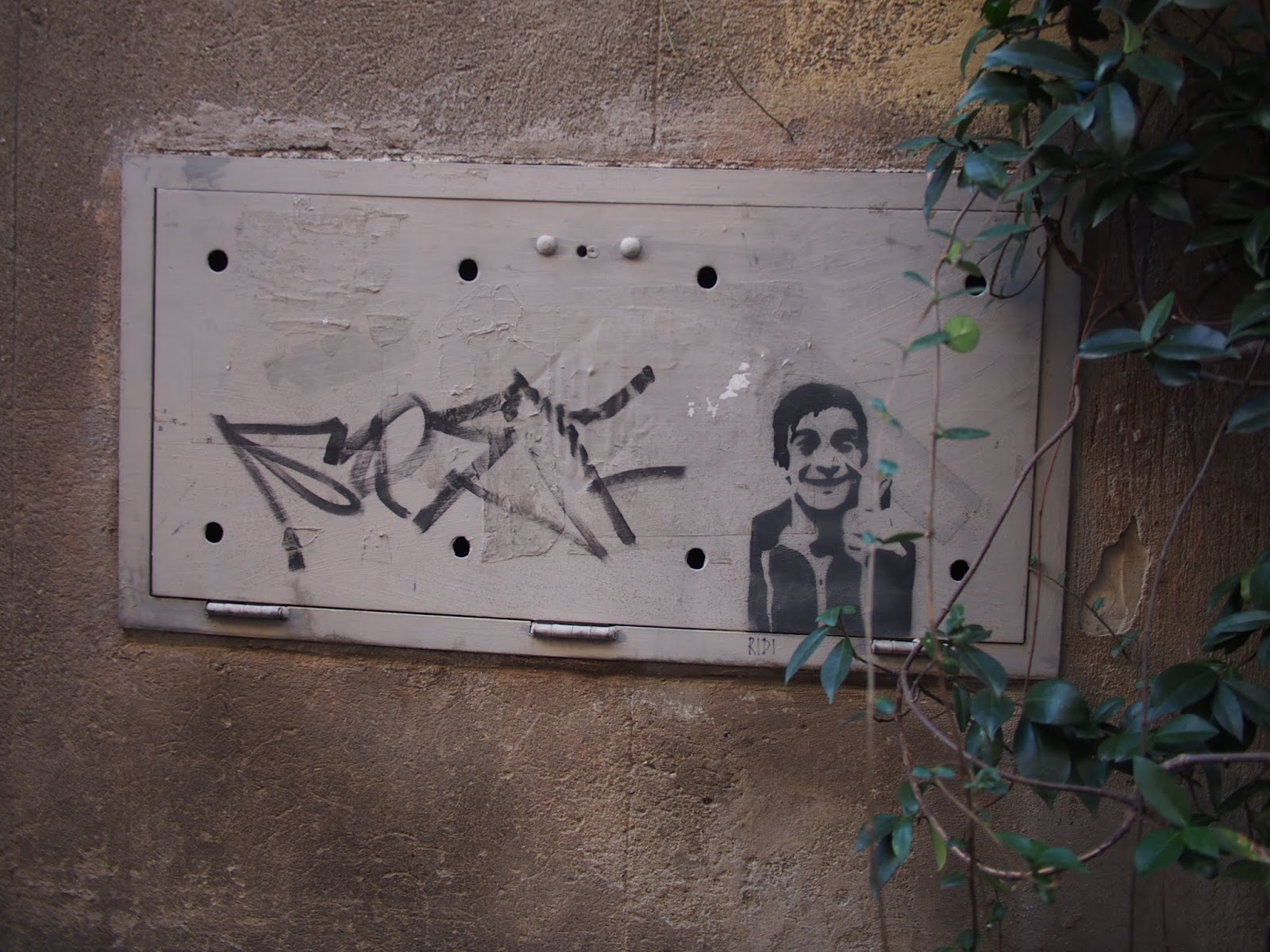 |
| Service access hatches to buildings make fine picture frames, though not everyone sees the need for a frame |

 |
| We both enjoy capturing images. One might ask if it distracts from seeing but our experience is of sharpened vision, alert to images. Taking pictures often with a camera I begin to see things in the format of the photo, in which details acquire more meaning, more whimsy, more knockout beauty. Harder to see this at home in spacious suburban life. |
I agree with something I found years ago, written by James Lomax, a photographer, in counterpoint to Susan Sontag's argument that photography is inherently aggressive. Lomax wrote:
"Sometimes, the photographic gaze is gentle, poetic, and creates beauty where it doesn’t obviously exist... This power to observe into life, with miniaturised paper or pixel images, is an extension of human capacity in the McLuhan sense, technology being an extension of the cerebral or nervous system. Photography is embedded within life, qualitatively different from other arts because you ‘take snapshots’ of it – take parts of it – for an ambiguous subsequent reflection, either in a book or on a VDU.Lomax's essay is here. I present here a link to something entirely different about composition of images and sensations, the art of Wes Anderson. Though fearful that you may never return.
 |
| There are so many options in the photo above for portraits of small parts of the wall, fascinating details, forms, colours. Along the street in the last several days, after stormy days, people have been lovingly restoring their little green comb-overs. And, um, oh gosh, the cobblestones are not blue, they are basalt, the camera has done something delicious. |
 |
| A book editor who may have opinions on these imposed writings. |
 |
| A life... let's blame the wind and rain for the mat being out of alignment with everything else. |

 |
| This is the Monti [hills] district, it's uphill that way |

 |
| My street, I can smell it. It's my street, and Bruno's and Ricky's and Monica's and Angelina's and and oh yes! — Violetta's street too!! And if I can draw you away from the dog for a moment... Look carefully at the pattern of cobblestones, the placing of cobblestones is an extraordinary art, found everywhere. |
-----
And here, very briefly, is how to walk down the street and not see it at all...